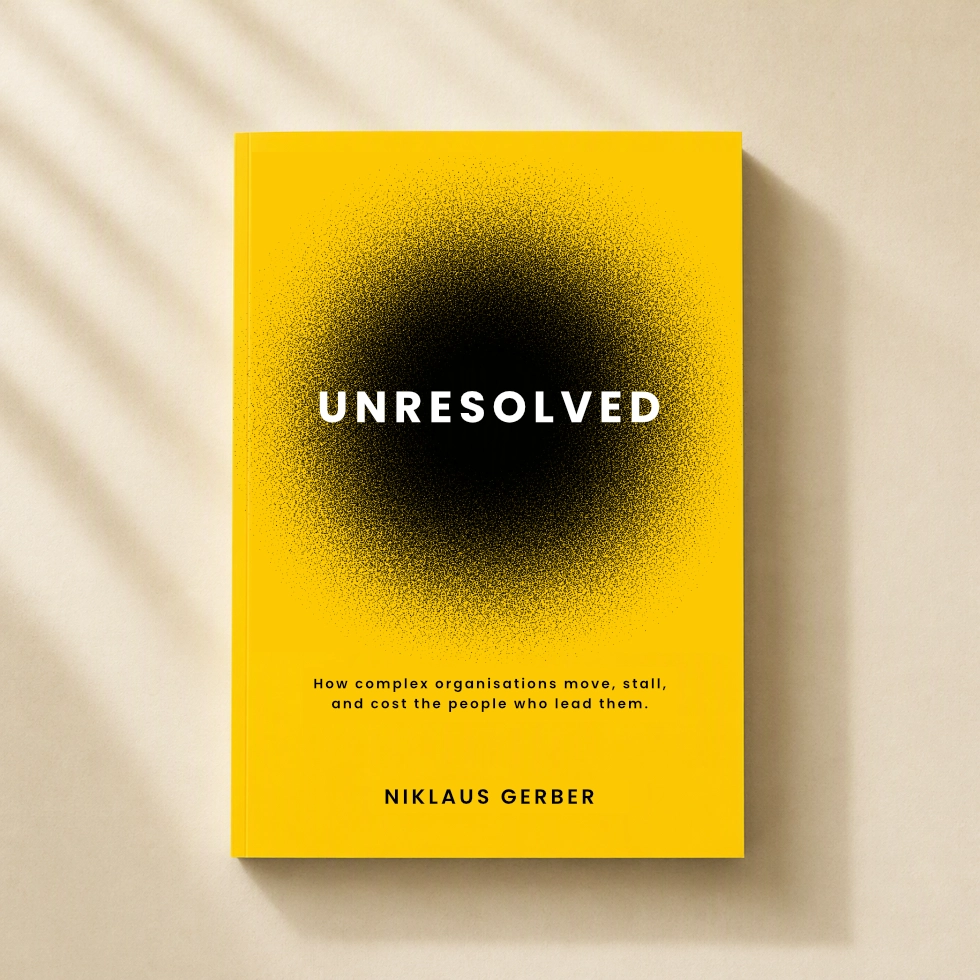
Unresolved
How complex organisations move, stall, and cost the people who lead them
Coming 2 September 2026
Paperback and Kindle.
Most complex organisations are not failing.
They are moving, producing output, hitting milestones. And yet something is always slightly wrong. Decisions that should be simple take months. Teams that should connect run in parallel. Energy that should go outward turns inward.
The problem is rarely ambition. It is almost never the people. It is what stays unresolved.
The trade-off no one named. The decision made but never quite landed. The conflict managed instead of addressed. The question left unasked, because asking it would force someone to take a position.
None of it announces itself. It accumulates. And it quietly becomes the thing that slows everything down.
Unresolved tension is not neutral. It accumulates interest.
What this is
Not a framework, not a system, not a set of practices. A series of precise observations, drawn from twenty years inside complex, legacy, multi-market organisations, on how enterprises actually move or get stuck, and what it costs the people who lead them.
Short chapters. Nothing wasted.
The book is in four parts, in the order transformation actually unfolds.
How organisations get stuck. Why systems stall through structural misreading, not failure of intent.
How decisions actually move. The mechanics of commitment, revision, and the judgement of good enough.
What happens between people. Conflict as signal. Reactivity as contagion. The space between stimulus and response.
What leadership actually costs. Blind spots at distance. The discipline of letting go. Accountability carried alone.
Who it is for
For those who already know the frameworks and want the thing frameworks cannot give. Language for what they have already lived, and clarity about what stays unresolved even when the strategy is right.
If none of that is familiar yet, the book will read as abstract. If it is, some of it may save you a year.
A page from it
From the opening chapter, “The wrong place to look.”
Under pressure, leaders often default to one move: they look for intent.
Why did they block this? Why are they slow? Why are they being difficult?
In large, complex organisations, that is usually the wrong place to look.
Outcomes are more often shaped by structure than by malice. Unclear ownership. Conflicting incentives. Decisions never fully closed. Teams operating at the edge of capacity.
When these signals are misread as bad intent, two things happen. A system problem becomes personal. And the system stops getting fixed.
The book is diagnostic in its first parts and personal in its last. Somewhere in the fourth, a team teaches me to let go of an idea I had held too long, and I learn that letting go is a muscle, not a moment.
Why I wrote it
I started collecting these the way you pick up stones on a walk. Small things. A line that helped me hold steady in a hard week. A sentence I could hand to a team without a slide behind it.
Over twenty years, mostly at senior levels where the outcomes could not be handed off, I noticed the same thing again and again. The technology was rarely the hard part. What was hard was almost always human. The decision no one would close. The trust that had to be rebuilt before anything could move. The tension everyone felt and no one named.
I looked for the book that named those things plainly, without turning them into a method. I never found it. So I wrote it.
It is not a book of answers. It is the one I wish someone had handed me earlier.